For example: farmers, moto-taxi drivers, artisans and tailors, traders, transport and housing cooperatives, and savings and credit cooperatives (SACCOs).
A member register that keeps itself up to date. Register members with their national ID. Membership numbers are assigned automatically.
Every franc has its proof. A second person verifies each payment before it counts. A mistake is fixed with a reversal that records its reason, never by deleting the record.
Loans from request to the last repayment. Each step is done by a different person.
Your books, written as you work.
You do not need to be an accountant.
Reports RCA expects, ready to send.
The annual pack to RCA as a single ZIP file.
Share the surplus the way the law says.
e-Mali proposes the Art. 97 split and calculates each member's dividend from their paid-up shares.
Moving from paper or Excel.
Fill in our bilingual Excel template. e-Mali checks every row and shows you any errors.
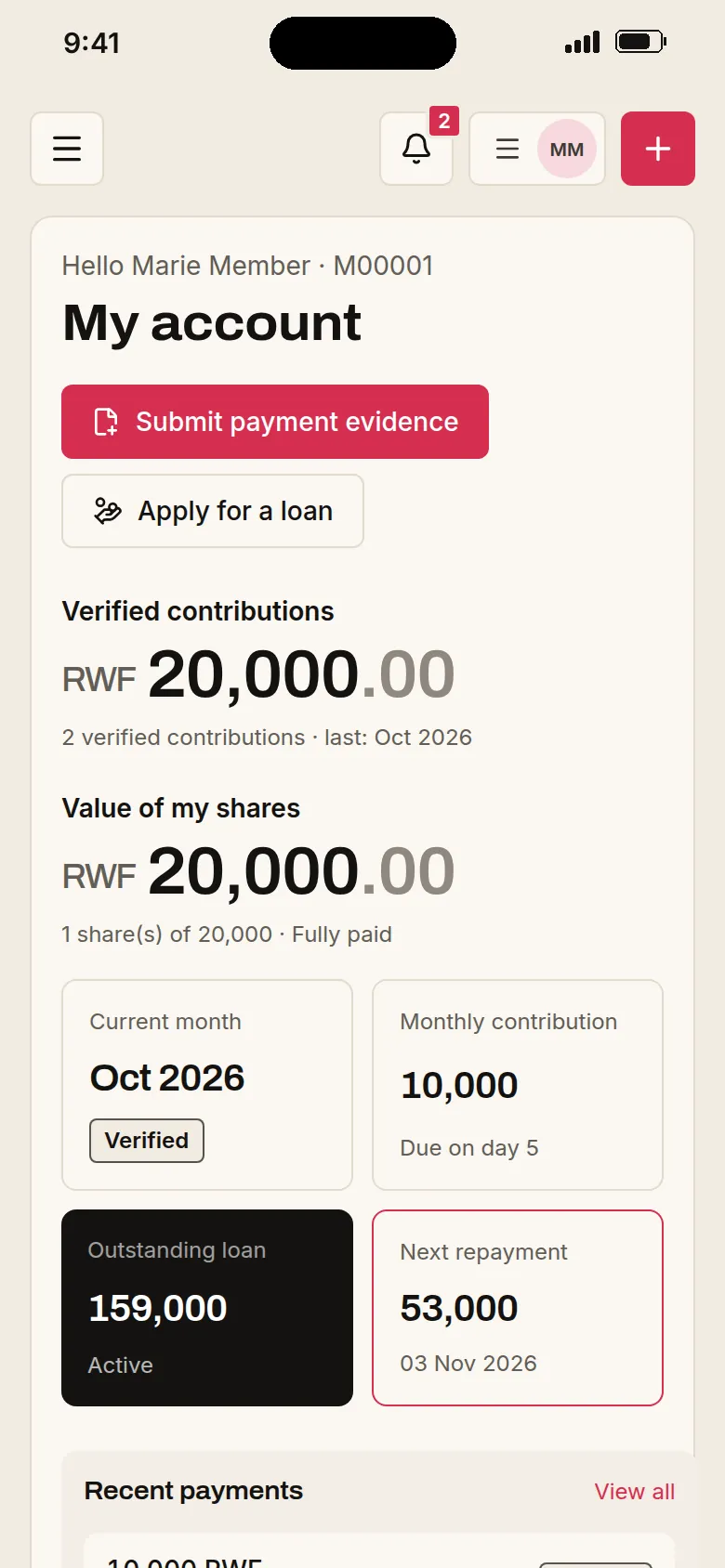
Members sign in with their phone number and a PIN. They see their savings, shares, loans and dividends, and can send a payment with a photo of the receipt.
Most cooperatives and savings groups still run on notebooks, spreadsheets and a cash box. Here is what that costs them, and what e-Mali changes.
Proof attached
A
Records and trust
Safe even when the notebook isn't. Rain, fire or a lost bag can wipe out years of records. In e-Mali they are kept online, not in one person's bag.
Know your balance any day, not just meeting day. Members check their own savings and loans on their phone, instead of asking the secretary and taking their word for it.
No more "I paid, but it isn't written." Every payment carries its proof and is checked by a second officer, so there is nothing to argue about.
Leaders change. The records stay. When the treasurer travels, falls ill or steps down, the next one picks up exactly where they left off.
RWF370,000.00
Money and calculations
Every franc counted right, every time. Interest, fines and contributions are worked out for you, so the totals never depend on someone's arithmetic.
Every loan and every late payment at a glance. See who borrowed, what is left to repay and who is late, without flipping through pages.
Year end in minutes, not weeks. Cooperative dividends and savings group share-outs are worked out from the records, and every member can see how.
Paid by MoMo? It is on the record. The MoMo message or bank slip is attached to the payment, so it lands on the right member.
18 / 24
1
2
3
Meetings and admin
Spend meetings deciding, not counting. Payments are recorded as they come in, so nobody waits in a queue for the secretary or the accountant to write.
Members, shares, savings and loans in one place. One register instead of separate lists that never agree with each other.
Less paperwork for the people who keep the group going. Leaders give their time for free. e-Mali does the writing and the adding up.
General assembly minutes that never go missing. Meetings, quorum, signed minutes and numbered decisions are kept next to the books.
RWF20,000.00
For members and partners
In Kinyarwanda, on your phone. Members sign in with their phone number and a PIN, and see their figures in their own language.
Records good enough for your SACCO or bank. Show a clean history of savings and repayments when the group applies for a loan.
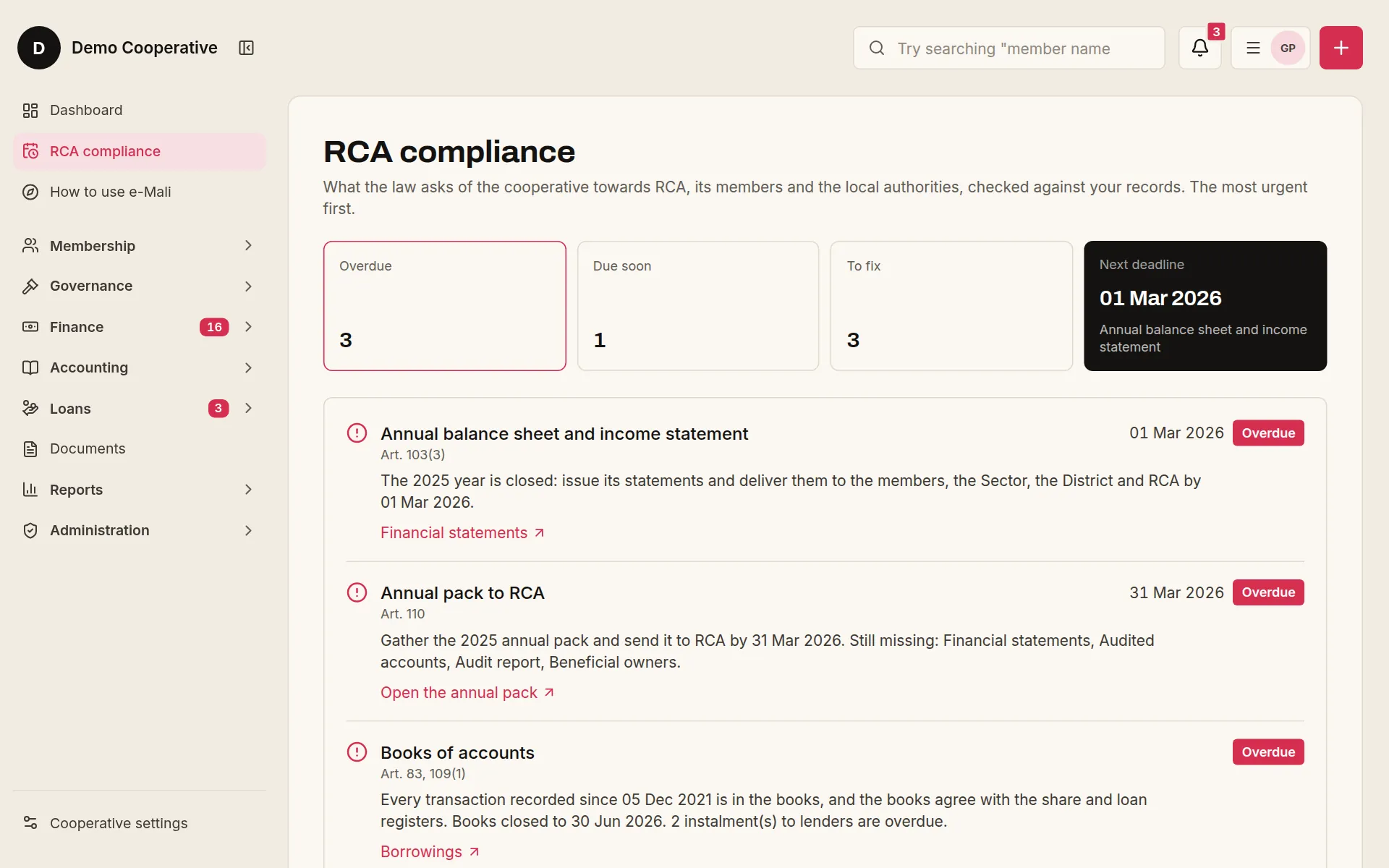
Reports ready when RCA or the sector asks. See what RCA expects and by when, and get reports straight from the records, as PDF or Excel.
Questions groups ask us
What is a cooperative in Rwanda?
An association of people who join voluntarily to meet shared economic, social and cultural needs through a business they own and run democratically. Cooperatives are registered and supervised by the Rwanda Cooperative Agency (RCA), under Law N° 057/2024.
Is e-Mali only for village groups?
No. e-Mali works for any group that saves, lends or shares a profit, in Kigali or anywhere else in the country. Ibimina of students, colleagues at work, neighbors and church or alumni groups can use it, and so can cooperatives of drivers, artisans, traders and farmers. Members only need a phone to check their balance.
Which books of accounts must a cooperative keep?
RCA lists twelve: the cash book, debtors' book, creditors' book, register of members' shares, purchases book, sales book, stock records, intangible documents, invoices, delivery notes, the balance sheet and the income statement. e-Mali keeps the cash and bank books, the share register and the financial statements for you as you work.
Does our group need to be registered first?
No. Any cooperative or savings group can start right away. If you register later, your records will already be in order.
Can we bring our existing records?
Yes. Fill in our Excel template and e-Mali checks every row before importing. We will help you do it.
What is the difference between a cooperative and an ikimina?
A cooperative is a business owned by its members, registered with RCA, and it keeps full books of accounts. An ikimina is a savings group: members contribute on a schedule, often lend to one another and share out at the end of the cycle. Ibimina register with their sector through MINECOFIN's IBIMINA platform. e-Mali works for both.
Ready to see your group's money clearly?
Set up your cooperative or savings group (ikimina) today. We will help you import your records and get your team started.